
Improved linearity, stability, and thermal performance of multi-mesa-channel AlGaN/GaN HEMTs

Authors

  • Joel Tacla Asubar ⋅ JP University of Fukui
  • Hirokuni Tokuda ⋅ JP Graduate School of Engineering, University of Fukui
  • Masaaki Kuzuhara ⋅ JP Graduate School of Engineering, University of Fukui
  • Zenji Yatabe ⋅ JP Priority Organization for Innovation and Excellence, Kumamoto University
  • Kenya Nishiguchi ⋅ JP Research Center for Integrated Quantum Electronics, Hokkaido University
  • Tamotsu Hashizume ⋅ JP Research Center for Integrated Quantum Electronics, Hokkaido University

DOI:

https://doi.org/10.20526/pisika.01a18.11

Abstract

With its wide bandgap of 3.4 eV, gallium nitride (GaN) is considered as a key semiconductor material for realizing ultra-low-loss power devices. However, GaN-based devices is still plagued by current collapse, which is the temporary reduction of current after application of electrical stress. In this work, we present the state-of-art Multi-Mesa-Channel (MMC) AlGaN/GaN HEMT being developed in our laboratory. The MMC HEMT is fabricated in a way to realize parallel mesa-shaped nano-channels separated by trenches. Investigations have revealed that the MMC HEMT is highly resistant to current collapse and other instabilities, making it a leading power electronics prospect.
Downloads

Issue

Message from the Editor-in-Chief

Welcome to the maiden online issue of PISIKA.

PISIKA is a bi-annual online journal that was conceived to provide physicists and physics educators, both from the Philippines and abroad, an accessible reference and online resource.  The name “PISIKA” pays homage to the quarterly journal previously published by the Samahang Pisika ng Pilipinas (SPP), which was launched in October 2007.  With this online journal, it is hoped that the dissemination of research output and sharing of scientific knowledge will be more expedient.

The articles appearing in this issue are select, peer-reviewed papers presented during the 36th SPP Physics Conference held in Palawan, Philippines from June 6 to 9, 2018.  In the future, this online journal will welcome submission of articles from the following research fields: astrophysics and atmospheric physics, complex systems, computational physics, condensed matter physics, instrumentation physics, lasers and their applications, liquid crystals, materials science, mathematical physics, optics and photonics, physics in medicine and biology, plasma physics, signal and image processing, theoretical physics, and physics education research, among others.

 On behalf of the interim Editors-in-Chief, I would like to thank the members of the advisory panel and topical editors composed of experts in the fields of Photonics, Material Science, High Energy Physics, Computational Physics and Plasma Physics.  PISIKA, as the Philippines’ first online physics journal is a testament to their invaluable contributions. 

Thank you very much.


Interim Editor in Chief

About the Cover:

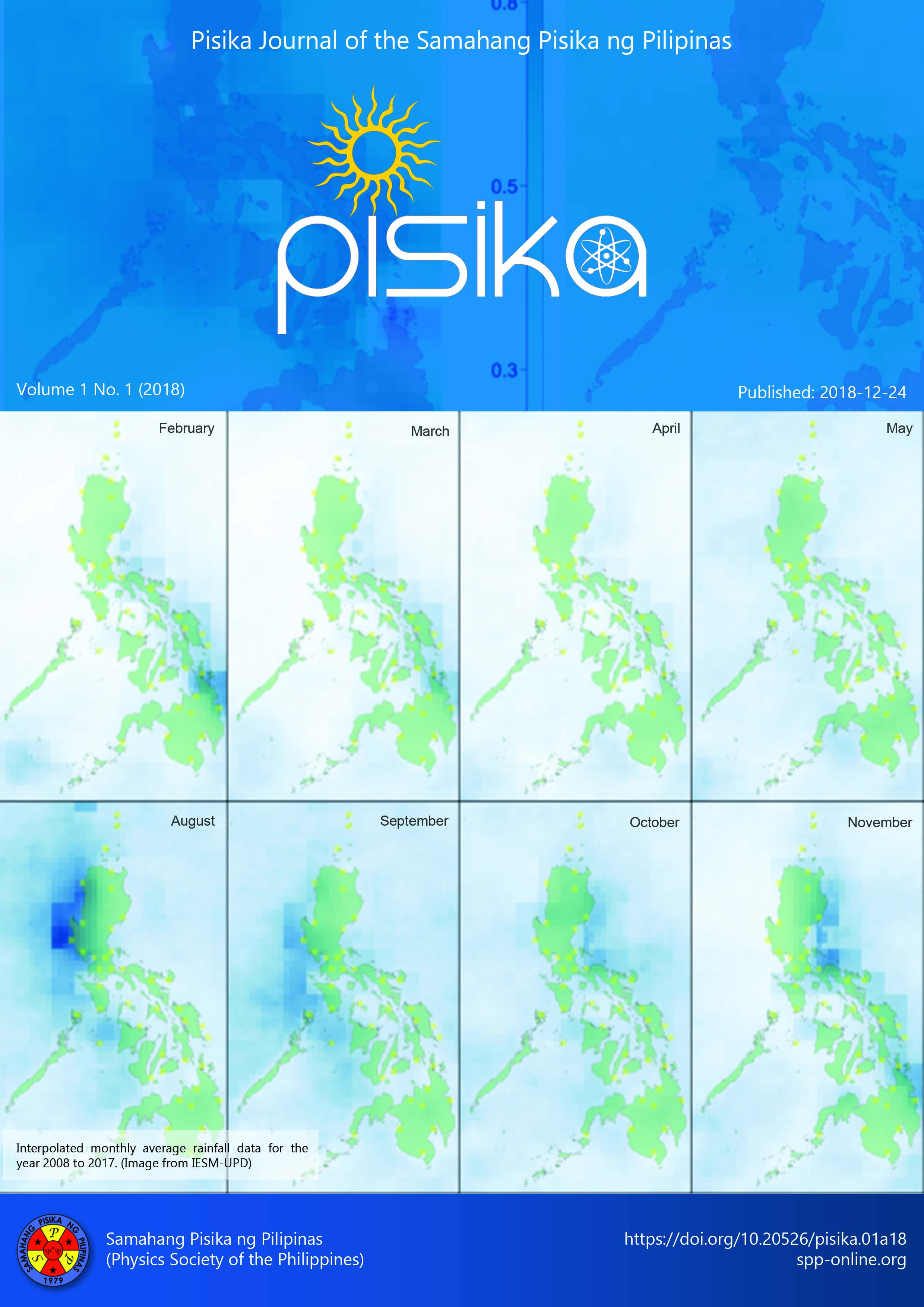
Monthly averaged Tropical Rainfall Measuring Mission (TRMM) satellite images for the years 2008-2017. See article by Archie Ilarian Veloria and co-authors, DOI: 10.20526/pisika.01a18.01. Cover art by Miguel Y. Bacaoco.


Article ID

11

Section

Articles

Published

2018-12-24

How to Cite

[1]
JT Asubar, H Tokuda, M Kuzuhara, Z Yatabe, K Nishiguchi, and T Hashizume, Improved linearity, stability, and thermal performance of multi-mesa-channel AlGaN/GaN HEMTs, PISIKA - Journal of the Physics Society of the Philippines 1, 11 (2018). URL: https://paperview.spp-online.org/pisika/article/view/01a18.11.